The house demolition process involves more than showing up with a bulldozer. From permit pulls and utility disconnects to asbestos inspections and debris haul-off, a properly executed demolition follows a defined sequence — and skipping any step creates real problems down the line. Here’s what to expect before, during, and after a structure comes down.
Before we even quote a demolition job at Demogodz, we ask three questions every property owner should know the answer to: Is the structure safe to approach? Are the utilities disconnected? And has anyone checked for hazardous materials? If the answer to any of those is “I don’t know,” that’s where the process starts.
What Is the House Demolition Process?
The house demolition process is the sequence of steps required to safely and legally tear down a residential or commercial structure — from initial assessment and permit approval through physical tear-down, debris removal, and site cleanup. The full timeline typically runs two to four weeks when permits and utility work are factored in, though the physical demolition of a standard residential home usually takes one to three days.
Step 1: Pre-Demolition Site Assessment
Every demolition starts with a walkthrough — not a phone call, not a photo review alone. A contractor needs to see the structure, the surrounding property, access points, and anything that could affect how the work gets done.
At Demogodz, our pre-demo assessment covers the structure’s size and materials, equipment access (fencing, overhead lines, neighboring structures), whether a concrete slab needs to be broken out, and any visible signs of hazardous materials. On older homes in communities like Garland, Terrell, and Mesquite — many built in the 1950s through 1970s — we regularly flag potential asbestos before the permit process even starts.
Did You Know? Homes built before 1980 may contain asbestos in floor tiles, insulation, pipe wrap, or roofing materials. While Texas’s mandatory licensed asbestos survey requirement applies primarily to commercial and public buildings, residential property owners are strongly advised to test before demo — not just for health reasons, but because disturbing asbestos without proper handling creates real liability. Your contractor should flag this risk during the site assessment.
This pre-assessment is also where we identify opportunities to scope the full project. For example, if the property also needs site prep and grading after the structure comes down, we scope that at the same time — keeping your project under one crew and one schedule.
Step 2: Permits and Utility Disconnects
This is the step that surprises most property owners, because it takes longer than the demo itself.
What Permits Are Required for Demolition in Texas?
Texas has no single statewide demolition permit — requirements are set by each municipality. Cities like Rockwall, Royse City, Forney, and Kaufman all have their own process and timeline. Most DFW-area cities require a permit before any structural work begins, and some require the permit to be posted on-site before equipment even arrives.
Your demolition contractor should pull this permit for you and include those fees in your quote. If a contractor hands you a permit application and says “you handle this,” that’s a red flag.
Utility Disconnects
Water, gas, and electric lines must be capped and disconnected before demolition starts. This isn’t optional — it’s a safety requirement under OSHA 29 CFR §1926.850(c), which mandates that all service lines be shut off, capped, or otherwise controlled outside the building line before demolition work begins. The scheduling process involves contacting each utility provider, confirming disconnects are complete, and getting written confirmation before work begins. In the DFW metro, larger utility providers can take three to seven business days to complete disconnects. Plan for this.
Pro Tip: Start the permit and utility disconnect process the same week you sign a demolition contract. Waiting until the contractor is ready to mobilize will delay your project by one to two weeks — and that delay often pushes back downstream construction timelines too.
Step 3: Hazardous Material Assessment
If the pre-demo survey flags asbestos, lead-based paint, or other regulated materials, abatement must happen before the structure comes down. Licensed abatement contractors handle this separately from demolition crews.
Under Texas Administrative Code Title 25, Chapter 296 — the Texas Asbestos Health Protection Rules administered by the Texas Department of State Health Services (DSHS) — commercial and public building owners are required to have a licensed asbestos survey completed before any demolition or renovation activity. For private residential demolitions, a state-mandated licensed survey is not required, but testing is strongly recommended on any pre-1980 home. Disturbing asbestos-containing materials without proper handling creates worker safety and legal liability exposure that follows the property owner long after the job is done.
We’ve seen abatement add anywhere from $1,500 to $10,000+ to a project, depending on how much material is present. On older homes in Waxahachie, Athens, Corsicana, and similar communities with mid-century housing stock, this step comes up more often than most homeowners expect.
Did You Know? DSHS requires a written demolition/renovation notification form to be submitted at least 10 working days before work begins on commercial and public buildings — even when no asbestos is found. DSHS administers asbestos survey and abatement requirements in Texas, while TCEQ handles asbestos waste disposal at permitted landfills. They are separate agencies with separate responsibilities.
Step 4: Physical Demolition
Once permits are in hand, utilities are confirmed disconnected, and any hazmat assessment is complete, the actual tear-down begins. What equipment gets used — and in what order — depends on the structure.
For a standard wood-frame home, a tracked excavator with a hydraulic thumb does most of the work. Brick structures require a breaker attachment or additional passes to break up masonry. Concrete slabs require a separate breaker setup or a large excavator bucket to pull and break sections. Our residential and commercial demolition services cover all of these scenarios.
The physical work on a typical 1,500–2,000 sq ft residential home takes one to two full days with the right crew and equipment. Larger structures, tight access situations, or selective interior demolitions take longer.
Pro Tip: If your property has underground utilities, a septic system, or a well, confirm their locations before the demo begins. Hitting an unmarked septic tank or water line during demolition adds cost and creates regulatory headaches.
Step 5: Debris Removal and Site Cleanup
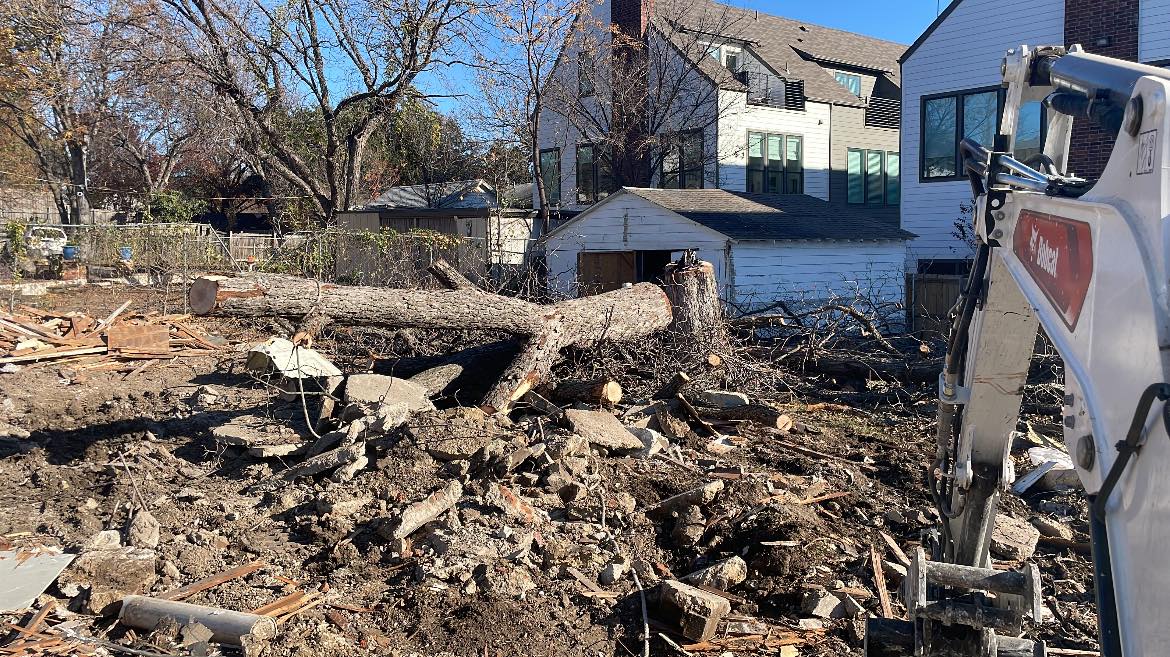
Demolition isn’t done when the structure hits the ground. Everything has to come off the property — concrete chunks, framing lumber, roofing materials, slab sections, and anything else that was part of the original structure.
We include debris haul-off in every demolition quote we provide. Some contractors don’t — they quote labor and equipment separately from disposal fees, and the final bill ends up significantly higher than the original number. Always confirm debris removal is included before signing any contract. For a full picture of what affects your final demolition cost, our DFW demolition pricing guide breaks down the variables in detail.
After haul-off, the site gets rough-graded to a clean, workable surface. If you’re building immediately after a demo, your contractor should leave the site in a condition that lets your next crew — whether that’s a foundation company or a site prep team — get started without delay.
Step 6: Post-Demo Inspection and Next Steps
Most municipalities require a final inspection after demolition to confirm the permit work is complete and the site is clear. Your contractor handles this coordination.
Once the site passes inspection, you’re ready for whatever comes next: new construction, land clearing, a pond build, or simply a clean property. According to the National Demolition Association, post-demo site preparation is one of the most overlooked phases — property owners often don’t account for rough grading costs until after the structure is already down, which creates scheduling gaps.
Did You Know? Combining demolition and site prep under one contractor typically saves time and reduces cost compared to coordinating separate crews. When demolition and grading are scoped together, equipment mobilization happens once instead of twice.
How Long Does the Demolition Process Take From Start to Finish?
For most residential demolitions in the DFW area, the full timeline from initial assessment to cleared site runs two to four weeks. The breakdown looks like this:
- Site assessment and quote: same week or within a few days
- Permit application and approval: three to ten business days, depending on the municipality
- Utility disconnect scheduling and confirmation: three to seven business days
- Hazmat assessment and abatement (if required): three to ten additional business days
- Physical demolition: one to three days for a standard residential structure
- Debris haul-off and site cleanup: one to two days
- Final inspection: scheduled within one to three days of site cleanup
The physical teardown is often the shortest part of the entire process. The paperwork and utility work are what take time — and starting both as early as possible is how projects stay on schedule. OSHA’s demolition safety standards under 29 CFR Part 1926, Subpart T govern how demolition work is sequenced on-site, covering everything from the pre-demolition engineering survey to utility shutoffs and mechanical equipment requirements.
Demogodz LLC handles residential and commercial demolition throughout the Dallas-Fort Worth metroplex and surrounding North Texas communities — from Rockwall and Kaufman County east to Sulphur Springs, south to Corsicana, and across the full DFW metro. Contact us today at (903) 782-1770 or request a free estimate online to get an honest quote and a clear timeline for your project.
Frequently Asked Questions About the House Demolition Process
What is the first step in the house demolition process? The first step is a pre-demolition site assessment, where your contractor evaluates the structure, access conditions, and any hazardous material concerns. This assessment shapes the permit requirements, equipment selection, and overall project timeline before any work begins.
Do I need a permit to demolish a house in Texas? Yes, in most DFW-area municipalities. While Texas has no single statewide demolition permit, cities like Rockwall, Forney, Garland, and Kaufman all require a local permit before demolition begins. Your contractor should pull this permit and include those fees in your quote.
How long does it take to demolish a house? The physical teardown of a standard residential home takes one to three days. The full process — including permits, utility disconnects, and site cleanup — typically runs two to four weeks from the initial assessment to a cleared, ready-to-use site.
What happens to the debris after demolition? All debris — concrete, framing, roofing, and slab material — is hauled off-site and disposed of at a licensed facility. Confirm that debris removal is included in your contractor’s quote before signing, as some contractors price this separately.
Do I need an asbestos inspection before demolition? Texas’s mandatory licensed asbestos survey requirement under TAC Title 25, Chapter 296 applies to commercial and public buildings, administered by DSHS. For private residential demolitions, a state-required survey isn’t mandated — but testing is strongly recommended on any pre-1980 home, since disturbing asbestos without proper handling creates worker safety and legal liability exposure.